
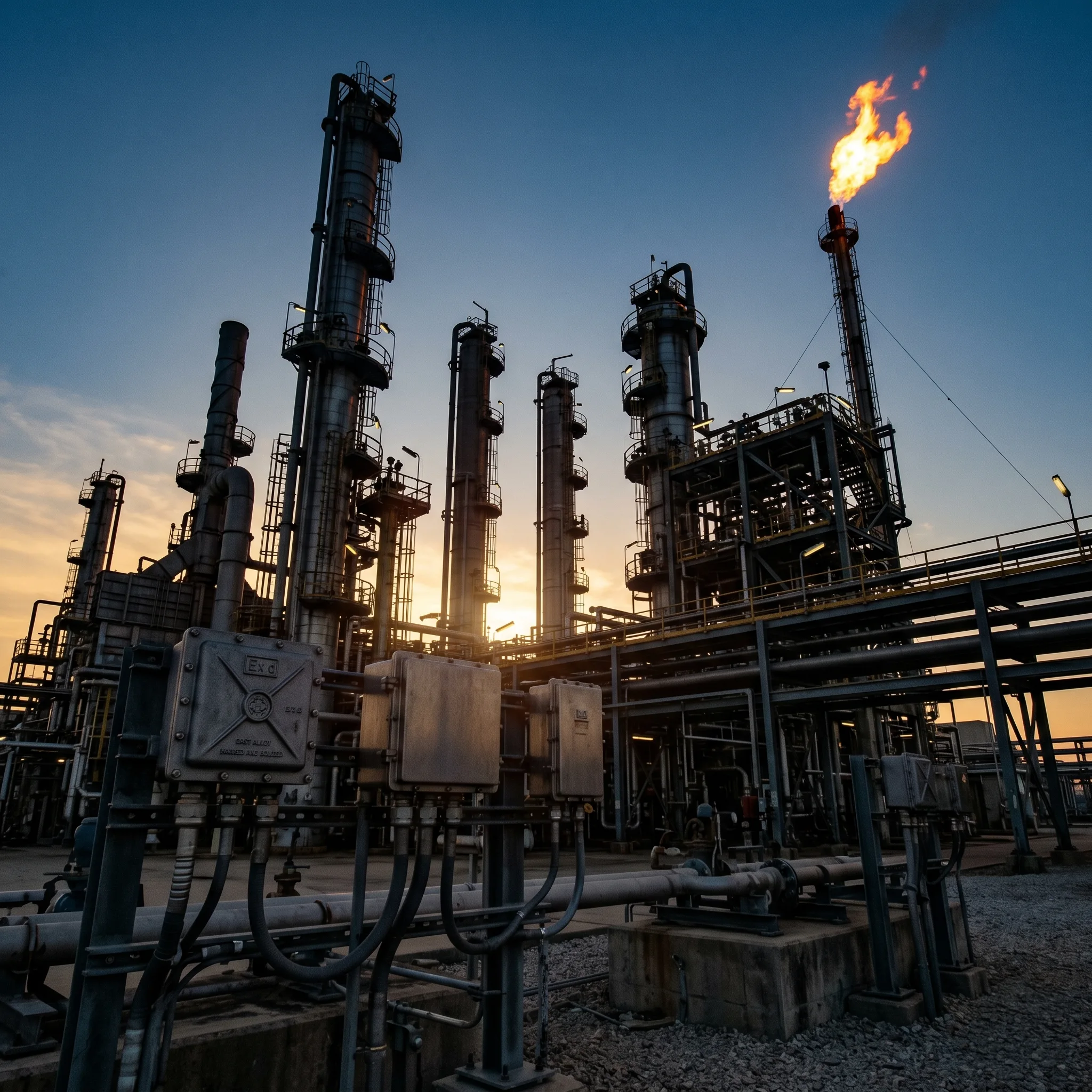
ATEX stands for Atmosphères Explosibles. It is the name given to two European Union directives that set out the rules for protecting people and workplaces from the risk of explosions caused by flammable gases, vapours, mists, or combustible dusts.
If your site handles substances that can form an explosive atmosphere when mixed with air, ATEX applies to you. It covers everything from oil refineries and chemical plants to grain silos, flour mills, and paint spray booths. The scope is broad because the physics of explosions does not care about industry labels.
The term ATEX comes from the original French title of the first European directive on the subject: "Appareils destinés à être utilisés en ATmosphères EXplosibles" (equipment intended for use in explosive atmospheres). The abbreviation stuck, and it is now used as shorthand for the entire regulatory framework across Europe and the UK.
There are two separate directives, and they do different things.
This directive applies to manufacturers and suppliers. It sets out the requirements that equipment must meet before it can be sold for use in potentially explosive atmospheres. That includes electrical equipment (motors, lighting, instrumentation), mechanical equipment (pumps, conveyors, fans), and protective systems (flame arresters, explosion vents).
Equipment covered by this directive must be tested, certified, and marked with an Ex marking before it can be placed on the European market. The certification process involves assessment by a Notified Body (an independent testing organisation approved by an EU member state), and the resulting marking tells the end user exactly where and how the equipment can safely be used.
This directive applies to employers and site operators. It places a duty on anyone who runs a work place where explosive atmospheres could occur to assess the risks, classify the hazardous areas into zones, select appropriate equipment for those zones, and put in place measures to protect workers.
Under this directive, employers must produce and maintain an Explosion Protection Document(EPD). The EPD records the risk assessment, the zone classification, the equipment installed, and the protective measures in place. It is a living document that needs to be updated whenever the site changes.
Since the UK left the European Union, ATEX directives no longer apply directly as EU law. In practice, though, the requirements are the same. The ATEX Workplace Directive was transposed into UK law through the Dangerous Substances and Explosive Atmospheres Regulations 2002, commonly known as DSEAR. DSEAR mirrors the obligations of the EU directive: classify your hazardous areas, assess the risks, select the right equipment, maintain it, and document the lot.
On the equipment side, the UK's Supply of Machinery (Safety) Regulations and related statutory instruments continue to align with the ATEX Equipment Directive. Equipment certified to the EU's ATEX standards is accepted in the UK, and the UKCA marking (or continued recognition of CE marking) applies to products placed on the UK market.
An explosive atmosphere is a mixture of air with flammable substances (gas, vapour, mist, or dust) in proportions that allow it to ignite. Not every concentration is dangerous. The substance needs to be within its explosive limits: above its Lower Explosive Limit (LEL) and below its Upper Explosive Limit (UEL). Outside that range, the mixture either has too little fuel to ignite or too much fuel and not enough oxygen.
The practical concern is that many common industrial materials fall within those limits in normal or foreseeable fault conditions. Methane in a mine, propane at a bottling plant, flour in a bakery, wood dust in a furniture workshop. The variety is wide, and it is not limited to obvious petrochemical settings.
One of the key obligations under the ATEX Workplace Directive is to classify hazardous areas into zones based on how likely an explosive atmosphere is to be present. There are three zones for gas/vapour environments (Zone 0, Zone 1, Zone 2) and three for dust environments (Zone 20, Zone 21, Zone 22). The lower the zone number, the more frequently the explosive atmosphere is expected to occur.
Zone classification determines what category of equipment can be used in each area. Equipment rated for Zone 0 must meet the strictest protection standards; equipment rated for Zone 2 can meet a lower standard because the risk is less frequent.
For a detailed breakdown of each zone, including what they mean in practice and how they are determined, see our full guide: ATEX Zones Explained.
Equipment certified under the ATEX Equipment Directive is assigned to one of three categories, which correspond to the zones where the equipment can be used:
Category 1equipment has at least two independent means of protection, so even if onefails, the equipment will not become a source of ignition. Category 3 equipmenthas a single means of protection and is only suitable for areas where anexplosive atmosphere is unlikely to occur under normal conditions.
ATEX is a European regulatory framework. It applies in EU member states and, through DSEAR, in the UK. If you operate outside Europe, ATEX does not automatically apply, though many countries recognise ATEX-certified equipment.
IECEx is the international equivalent. It stands for the IEC System for Certification to Standards Relating to Equipment for Use in Explosive Atmospheres. Unlike ATEX,IECEx is not a legal directive. It is a voluntary certification scheme administered by the International Electrotechnical Commission (IEC) that harmonises standards globally. Organisations operating across multiple countries often use IECEx certification to demonstrate compliance in different jurisdictions without duplicating testing and assessment.
In practice, both systems reference the same underlying IEC 60079 series of standards. Apiece of equipment certified to IEC 60079 under the IECEx scheme will generally meet the technical requirements of ATEX as well, though the administrative and marking requirements differ.
Every piece of ATEX-certified equipment carries a standardised marking. It looks something like this:
Ex II 2 G Exd IIB T4 Gb
Each element encodes specific information:
• Ex: the equipment is certified for use in explosive atmospheres.
• II: Equipment Group II (surface industries). Group I is mining.
• 2: Category 2 (suitable for Zone 1 and Zone 2).
• G: Gas/vapour environment (D would indicate dust).
• Ex d: the protection concept (in this case, flame proof enclosure).
• IIB: the gas group (IIA, IIB, or IIC, based on the ignition energy of the gases present).
• T4: temperature class (the maximum surface temperature the equipment can reach).
• Gb: Equipment Protection Level (EPL), indicating the level of protection provided.
Understanding this marking matters because it determines whether a piece of equipment is suitable for a specific location. Installing equipment with the wrong marking in a classified hazardous area is a compliance failure and a safety risk.
Getting equipment certified and installed is only the beginning. Under both ATEX and DSEAR, there is an ongoing obligation to inspect and maintain that equipment throughout its operational life. The standard that governs this is IEC60079-17, which defines how, when, and to what level hazardous area equipment must be inspected.
For a detailed explanation of the inspection process, including the three grades of inspection, the four inspection types, and what inspectors actually check, see our guide: What Is ATEX/IECEx Inspection? [link to existing inspection blog]
If you operate in Europe or the UK and your workplace includes areas where explosive atmospheres can form, ATEX (or DSEAR) is not optional. The obligations cover hazardous area classification, equipment selection, installation, ongoing inspection, and documentation. Getting this wrong exposes your workforce to explosion risk and your organisation to regulatory enforcement.
The practical challenge for organisations is not understanding the regulations and ATEX zones and equipment categories in principle. It is managing the detail in practice: maintaining an accurate equipment register, keeping inspection records up to date, and being able to demonstrate compliance to an auditor at any point. This is where purpose-built Ex inspection software like Nexar makes the difference, by centralising all of that information in one place and generating the right inspection checklists automatically based on each piece of equipment's certification and protection concept.


