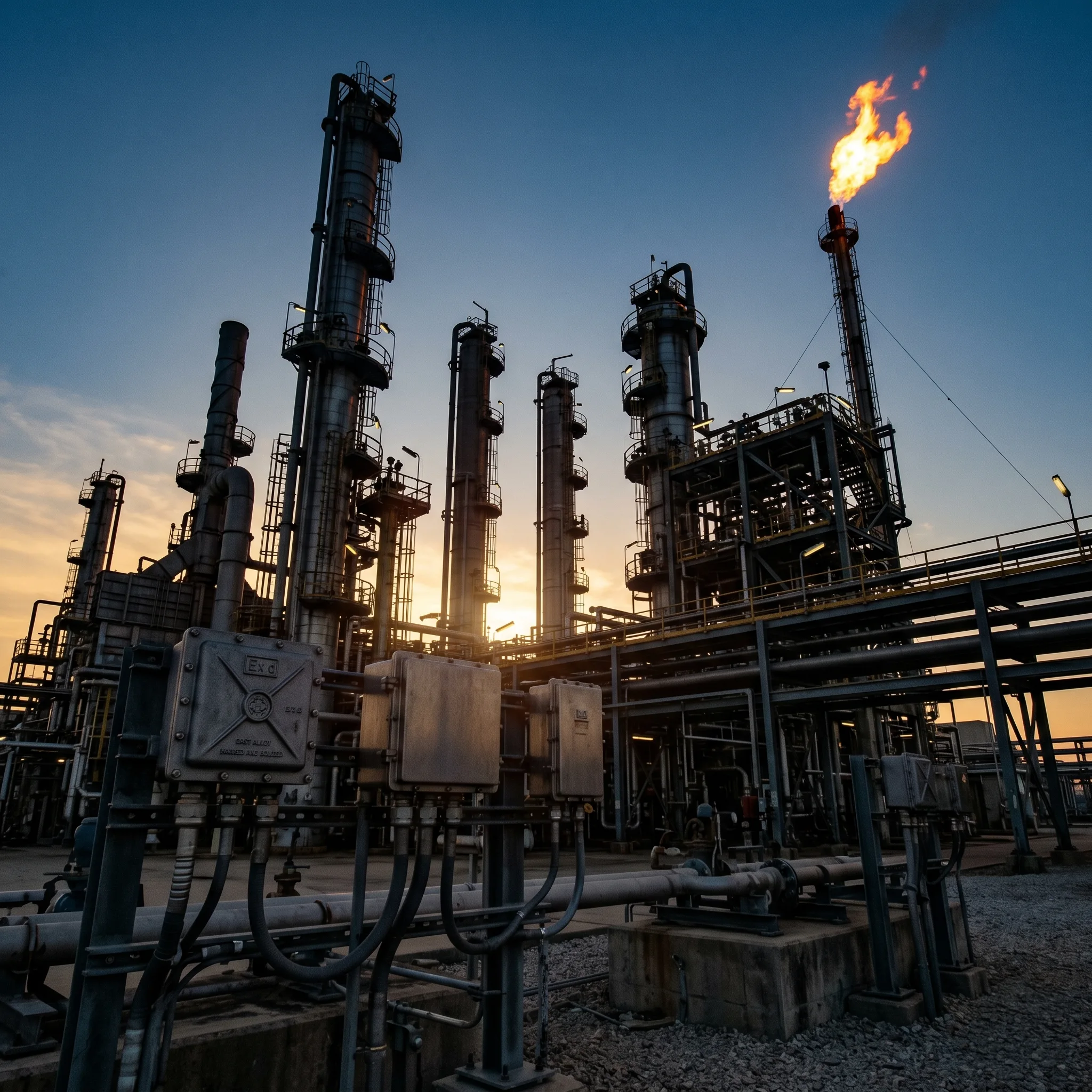
ATEX zones classify hazardous areas by how often an explosive atmosphere is present — Zones 0/1/2 for gases and 20/21/22 for dusts — and each zone dictates the equipment category (1, 2 or 3) allowed to operate in it.
The classification determines what type of equipment can be safely installed and used there. If you operate a site with flammable gases, vapours, mists, or combustible dusts, getting the zone classification right is one of the first and most important steps in managing explosion risk.
Zone classification is required under the ATEX Workplace Directive (1999/92/EC) in Europe and under DSEAR (the Dangerous Substances and Explosive Atmospheres Regulations 2002) in the UK. The methodology is set out in IEC 60079-10-1 for gas/vapour environments and IEC 60079-10-2 for dust environments.
For background on what ATEX is and how the directives work, see our guide: What is ATEX? [link to What is ATEX? blog]
The basic principle is straight forward. Every area where an explosive atmosphere could form is classified according to how often that atmosphere is likely to be present. More frequent presence of an explosive atmosphere means a lower zone number and stricter equipment requirements.
There are two parallel sets of zones: one for gas and vapour environments, and one for combustible dust environments. They follow the same logic but use different numbering to distinguish between the two hazard types.
An area where an explosive gas atmosphere is present continuously, for long periods, or frequently. This is the highest-risk classification. Examples include the inside of a storage tank containing flammable liquid, the vapour space above a volatile solvent in a closed vessel, or the inside of a pipeline carrying flammable gas.
Zone 0 areas are relatively uncommon in most facilities because they typically exist inside enclosed process equipment rather than in open working areas. Equipment installed in Zone 0 must be Category 1 (the highest protection level) and is usually limited to intrinsically safe (Ex i) or specially certified apparatus.
An area where an explosive gas atmosphere is likely to occur occasionally during normal operation. This is the most common classification for areas immediately surrounding process equipment that handles flammable substances. Think of the area around a pump seal on a petrochemical plant, the space near a sampling point where gas could be released during routine operations, or the vicinity of a relief valve.
Zone 1 requires Category 2 equipment or higher. Most of the common protection concepts are available for Zone 1 use: flameproof (Ex d), increased safety (Ex e),pressurised (Ex p), and others.
An area where an explosive gas atmosphere is not likely to occur during normal operation, but if it does, it will only be present for a short time. Zone 2 covers areas where a hazard exists only under abnormal or fault conditions, such as a flange leak, a gasket failure, or a process upset.
This is the least restrictive gas zone. Category 3 equipment is acceptable here, though higher-category equipment can obviously be used too. Many general-purpose industrial areas around process plants are classified as Zone 2 because the risk is low but not zero.
An area where an explosive dust cloud is present continuously, for long periods, or frequently. Zone 20 conditions exist inside equipment like dust collectors, hoppers, silos, and cyclone separators where combustible dust is handled or stored. As with Zone 0 for gas, Zone 20 typically exists inside enclosed process equipment rather than in occupied workspaces.
Equipment for Zone 20 must be Category 1, with the highest level of protection against ignition.
An area where an explosive dust cloud is likely to occur occasionally during normal operation. This could include areas around bag dump stations, powder transfer points, or conveyor discharge points where dust escapes into the air during routine handling. Zone 21 is the dust equivalent of Zone 1.
Category 2equipment is required in Zone 21.
An area where an explosive dust cloud is not likely under normal operation but could occur briefly under abnormal conditions. Zone 22 areas often surround Zone 21 areas, covering the wider space where dust might occasionally accumulate or become airborne. Warehouses storing bagged combustible materials and areas adjacent to dust-generating processes are often classified as Zone 22.
Category 3equipment is acceptable in Zone 22.
Under ATEX and DSEAR, the duty to classify hazardous areas falls on the employer or the person responsible for workplace safety. In practice, zone classification is usually carried out by a competent person with specific knowledge of the process, the substances involved, and the relevant standards (IEC 60079-10-1 and IEC60079-10-2).
On many sites, this means involving a speciailst hazardous area consultant, though the legal responsibility remains with the employer. The classification should be documented in the site's Explosion Protection Document (EPD) and reviewed whenever there are changes to the process, the substances handled, or the physical layout of the facility.
The classification process looks at three main factors for each area:
• The type and properties of the flammable substance (gas group, flash point, ignition temperature, dust particle size, and so on).
• The likelihood and frequency of a release (is the substance present continuously, intermittently, or only under fault conditions?).
• The ventilation and dispersion characteristics of the area (an enclosed room with poor ventilation will be classified differently from an open-air platform).
The assessment produces a zone map of the facility showing the extent and classification of each hazardous area. This map is then used to select equipment: every piece of electrical and non-electrical equipment installed in a classified zone must be certified to a category that matches or exceeds the zone's requirements.
The zone classification directly governs what equipment can be installed. Category 1equipment (the most protected) can be used in any zone. Category 3 equipment(the least protected) can only be used in Zone 2 or Zone 22.
This matters because there is a cost and complexity difference between categories. Category1 equipment is more expensive, has more limited product availability, and is harder to maintain. If your zone classification is wrong, you either end up with equipment that is over-specified for the risk (a waste of money) or, mor dangerously, equipment that is under-specified for the conditions.
Classifying the zones is the starting point, not the finish line. Once zones are established, every piece of equipment in those areas needs to be inspected throughout its service life to confirm it remains safe and compliant. The standard that governs this ongoing inspection is IEC 60079-17, which defines the grades, types, and intervals of inspection required.
For a full walkthrough of the inspection process, see our guide: ATEX/IECEx Inspection: Grades, Types and What IEC 60079-17 Requires.
On a small site with a handful of classified areas, managing zone documentation and equipment compliance is relatively straightforward. On larger or multi-site operations,it gets complex quickly. Zone maps need to be kept current, equipment registers need to reflect what is actually installed (not what was installed five years ago), and inspection records need to be traceable back to the specific zone and equipment they relate to.
This is where centralised Ex inspection management software makes a practical difference. Tools like Nexar hold the zone classification, the equipment register, and the inspection records in one system, so your compliance data is always connected and always accessible. When an auditor asks to see the inspection history for equipment in a Zone 1 area, you do not have to go looking through filing cabinets or spreadsheets to piece together an answer.